

|
|
|
 |
 |
 |
 |
 |
 |
 |
PRB.png) |
|

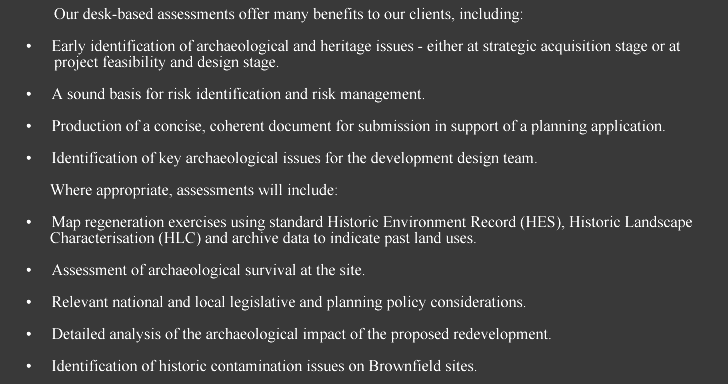
In considering planning applications for the development of either Greenfield or Brownfield sites, the Local Planning Authorities often request that an archaeological assessment of the proposed development site be carried out. Preliminary desk-based assessments of development proposals will indicate the likely nature and extent of archaeological remains that might be affected, and can help to suggest the best strategy for dealing with those remains. Likely developments where desk-based assessments will be required include; housing and industrial developments, business parks, landfills, mineral extraction, wind-farms, overhead power lines, opencast mining, and a range of pipeline developments.
The end product will be a report that will inform decisions regarding the need for further research, perhaps involving direct fieldwork investigation, and thereby aiding the planning process and the preparation of appropriate mitigation strategies. The results and subsequent report of the Desk-Based Assessment, can be used by developers to promote the historical significance of an area, as this helps to provide a 'sense of place' and 'community' in which we live. To find our more about how our desk-based assessments can help you, please contact us. Environmental Impact Assessments Larger development proposals such as mineral extraction, road schemes and industrial sites or developments in environmentally-sensitive locations often require an Environmental Impact Assessment (1997 EIA Directive), which involves aligning our objectives with the needs of the client, and co-operating within a wider team through a process called ‘master planning’. Such impact assessments comprise a similar programme of desk-based research as well as providing a detailed assessment of the predicted level of development impact on known or suspected archaeological remains.
|
  |
 |
 |
 |
All material on this website, including images, text and graphics, is copyright © 2008 Archaeology and Heritage Management Consultancy unless otherwise stated. The material on this site should not be used, copied, stored or transmitted without the prior written consent of Archaeology and Heritage Management Consultancy in accordance with the Copyright, Designs and Patents Act 1988. |