


|
|
|
 |
 |
 |
 |
 |
 |
 |
YRB.png) |
|

Test Pits and Archaeological Evaluations form part of three basic levels of direct investigation, as part of a pre-planning or post consent initial site assessment. This may also include auguring/borehole drilling (geo-archaeology). Test Pits and Trial Trench Archaeological Evaluations are often required prior to the determination of a planning application for development or conditions are often attached to Consent Notices requiring archaeological work to be undertaken prior to development works commencing on site. Test Pits and Evaluations are undertaken to determine the nature, extent, state of preservation and depth of buried archaeological remains. The results are central to informing planning decisions and the determination of mitigation strategies on site. Test pits of up to 2m² may be deliberately excavated to examine the archaeological deposits and nature of the underlying ground and geology.
If other information such as aerial photographs or geophysical surveys are available, the trial trenches will usually be sited to both intersect known features and to examine apparently blank areas, where there may be small features that have not shown up on other surveys. Our experience of working closely alongside developers means we can ensure that these surveys take place quickly and efficiently, by designing them in a targeted and selective way to control costs. In addition, if we are involved at an early enough stage, it is sometimes possible to combine archaeological evaluations with the developer's geo-technical investigations, so that further cost savings can be made. To find out more about archaeological evaluations and how this may affect your development, please contact us.
|
  |
 |
 |
 |
All material on this website, including images, text and graphics, is copyright © 2008 Archaeology and Heritage Management Consultancy unless otherwise stated. The material on this site should not be used, copied, stored or transmitted without the prior written consent of Archaeology and Heritage Management Consultancy in accordance with the Copyright, Designs and Patents Act 1988. |














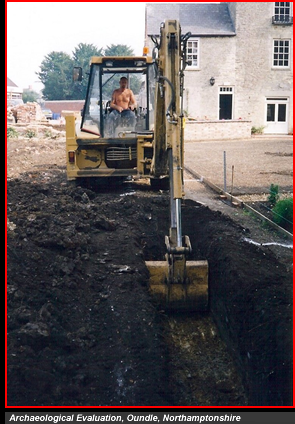 However, usually a series of trial trenches from 1.5 - 2.5meters wide and anything between 10meters and 100meters long, are excavated to determine the presence and nature of archaeological remains.